Wasp and Bee Removal in Clarksville, TN
A small paper wasp nest under the eaves is a do-it-yourself job at night. Yellowjackets in the ground or a wall, large hornet nests and anything in a household with a sting allergy are worth a professional, and honey bees should go to a beekeeper.
Call (931) 416-0793Ask for an inspection
Licensed companies only: a Tennessee Department of Agriculture charter, or a Kentucky license on the KY side.
On this page
Most stinging insect calls in Clarksville come down to four groups. Paper wasps and yellowjackets are the common ones, followed by bald-faced hornets and carpenter bees. Each needs a different answer. Honey bees are a fifth case, and in Tennessee the first call should go to a beekeeper, not an exterminator.
Paper wasps
University of Kentucky Entomology (ENTFACT-620, revised March 2026) describes paper wasps as mostly brown or rust-colored with a very thin waist. They build open, umbrella-shaped paper nests under eaves and gutters and behind shutters. Porch lights and grills are common spots too. UK describes them as not very aggressive.
For a small nest you can reach, UK says a wasp and hornet aerosol that sprays about 20 feet works, ideally at night when the wasps are home and slow. Do not stand directly under the nest. Wait a few days, then knock it down. For one nest, I would not pay for a contract. A one-time visit or a can of spray is enough.
Yellowjackets in the ground
Yellowjackets are the ones to take seriously. UK ranks them among the most dangerous stinging insects in the United States. They often nest underground in old rodent burrows or under rocks and timbers. They also nest in crawl spaces and attics or behind siding. By late summer a nest can hold thousands of wasps, and UK says nest defense can be intense.
Late summer and early fall is when yellowjackets show up at cookouts and trash cans. UK says colonies near maturity send out large numbers of workers looking for sweets and protein. Some practical points from UK:
- Pouring gasoline down the hole or blasting it with a garden hose seldom works and can get you stung many times.
- Insecticide dust works better than spray for ground nests, because it spreads deeper into the colony.
- Treat at night. Mark the entrance during the day so you can find it in the dark, and use indirect light so you do not startle the wasps.
- Traps rarely reduce late-season numbers. If you use them, put them at the edge of the yard, not next to the patio.
- Mosquito and tick repellents do not keep yellowjackets away.
A ground nest in a high-traffic part of the yard, or one near where kids play, is a reasonable job to hand off.
Wasps in a wall
If yellowjackets are going in and out of a gap in the siding, do not seal the hole. UK warns that the wasps may chew inward and come out inside the house. Wasps already inside the living space, or a nest you cannot see, are a reason to call now.
Bald-faced hornets
UK describes these as larger than yellowjackets and black and white, with a gray paper nest shaped like a bloated football. The nest usually hangs in a tree or bush or on the side of a building, often hidden in the leaves, and can hold hundreds of hornets. Treatment means working at night through a single opening at the bottom while wearing a full suit with a sealed veil. UK says it is often wiser to call a professional, or to leave a nest that is far from where people go.
Timing: nests die in the fall
UK says wasp and hornet colonies in cold-winter states die off once cold weather arrives, and abandoned nests are not reused. Clarksville's median first freeze is October 31, per our NOAA data. A hornet nest you find high in a tree in November is not worth paying to remove. Leave it and check the same spot next spring.
Carpenter bees in decks and fascia
Large black bees hovering around the deck or the eaves in spring are almost always carpenter bees. UK Entomology (ENTFACT-611, revised March 2026) says they look like bumble bees but have a shiny, mostly hairless abdomen. Bumble bees have a fuzzy abdomen with stripes. They nest in existing cavities, often underground.
Are they dangerous
Not to people, mostly. UK says males cannot sting at all, even though they hover aggressively near nests. Females can sting but rarely do unless handled.
Signs and damage
Look for a perfectly round hole about the diameter of your little finger, often with coarse sawdust below it. UK says the tunnel turns at a right angle and runs along the grain. Common spots are eaves and fascia boards, along with decks and outdoor furniture. They prefer bare, weathered softwood such as pine and cedar. Painted or pressure-treated wood is much less likely to be attacked.
UK says carpenter bees are seldom as destructive as termites. The damage builds when the same boards are used year after year, and the holes let in moisture that leads to rot. If you are not sure whether damage is bees or termites, our termite inspection page covers what a termite inspection looks for.
What works
- Treat in spring, before the tunnels are fully built. UK says insecticide applied right into the hole, as a dust or an aerosol, is what works.
- Leave the treated holes open for a few days so the bees spread the insecticide through the tunnel.
- Plug each hole with a wood dowel coated in carpenter's glue, or with putty. That keeps bees and water out.
- Paint the bare wood. UK calls painting the more permanent fix, and says stains and preservatives are less reliable.
UK says spraying the surface of vulnerable wood lasts only about 3 to 4 weeks, so a single spray in April will not protect a deck all season. Carpenter bee traps, hung at house corners and under deck overhangs in early spring, can catch bees as they search for nest sites. My view: if a few holes in the fascia are within safe reach, you can treat and plug them yourself. For a deck or second-story trim with dozens of holes, pay for one treatment and then paint or seal the wood, or you will be doing it again next year.
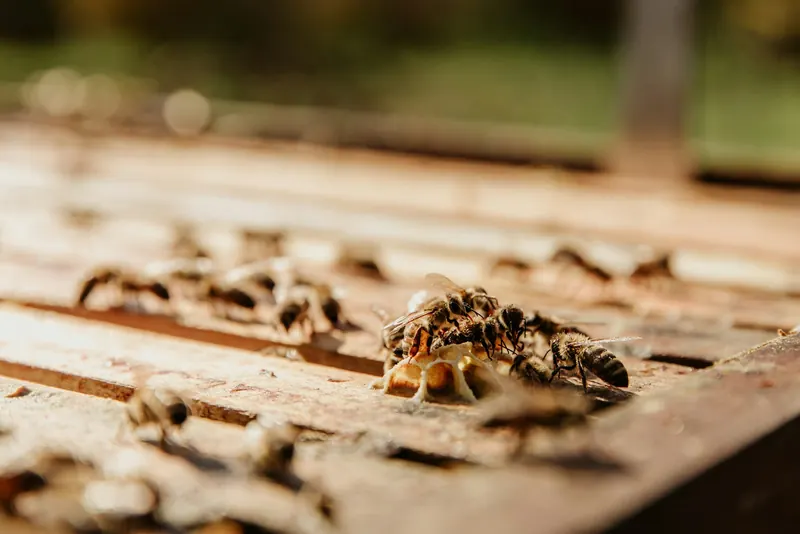
Honey bees: call a beekeeper first
The honey bee is Tennessee's official state agricultural insect, and the Tennessee Department of Agriculture's apiary program exists to protect it. A swarm is a cluster of bees hanging on a branch or a fence, often the size of a football. The department says swarms are usually docile for the first day or so because they are looking for a new home, not defending one. A swarm usually moves on within 24 to 48 hours. If no beekeeper is available, it will normally leave without causing a problem. Do not spray it.
The department keeps a Swarm Retrieval List of beekeepers willing to collect swarms, arranged by home county. Its apiary program can be reached at (615) 517-4451. The Tennessee Beekeepers Association also has a map of local bee clubs, and a local club is often the fastest way to find someone in Montgomery County.
Bees that have moved into a wall are a different job. The Department of Agriculture says not to try to remove them yourself. It takes a beekeeper to handle the bees and a carpenter to open and rebuild the wall. Killing the bees is a last resort, and even then the honeycomb has to come out, because wax is flammable and honey can ooze through the wall and attract other insects.
Stings and allergies
UK says most stings cause pain and swelling that ice and an antihistamine help, after washing the area with soap and water. About 1% of Americans are hypersensitive to venom. Hives or trouble breathing after a sting is an emergency, and so is swelling of the face or throat. Call 911. Anyone who has had a severe reaction should talk to a doctor about carrying an epinephrine auto-injector. UK also warns that a yellowjacket inside a soda can can sting the mouth or throat, so cover drinks outside in late summer.
If someone in the house has a sting allergy, I would not treat any nest yourself.
Getting a nest removed
We only refer companies chartered by the Tennessee Department of Agriculture (and licensed by the Kentucky Department of Agriculture for Kentucky addresses). For a single nest, ask for a one-time visit rather than a recurring plan. Our pages on one-time vs. quarterly service and costs help you compare. Renters should check who handles pests in a Tennessee rental first. Ask for a written price before any treatment.
Questions people ask
Should I remove a wasp nest myself?
A small paper wasp nest you can reach is a reasonable DIY job with a wasp and hornet spray at night. Yellowjackets in a wall or the ground, large hornet nests and any household with a sting allergy are better left to a professional.
How do I get rid of carpenter bees in my deck?
University of Kentucky Entomology says to put insecticide dust or spray into each hole in spring, leave it open a few days, then plug it with a glued dowel or putty. Painting bare wood is the more permanent fix.
Do carpenter bees sting?
Males cannot sting, even though they hover close. Females can, but University of Kentucky Entomology says they rarely do unless handled.
Who removes honey bee swarms in Tennessee?
The Tennessee Department of Agriculture keeps a Swarm Retrieval List of beekeepers by county; its apiary program is at (615) 517-4451. A swarm usually moves on by itself within 24 to 48 hours.
Why are yellowjackets so aggressive in the fall?
University of Kentucky Entomology says colonies near maturity send out many workers looking for sweets and protein in late summer. The colonies die off once cold weather arrives.
Sources
- University of Kentucky Entomology: Controlling Wasps, Hornets, and Yellowjackets (ENTFACT-620, revised March 2026)
- University of Kentucky Entomology: Carpenter Bees (ENTFACT-611, revised March 2026)
- Tennessee Department of Agriculture: Apiary (accessed October 28, 2026)
- Tennessee Department of Agriculture: Honey Bee Swarms (accessed October 28, 2026)
- Tennessee Department of Agriculture: Bees Inside a Wall (accessed October 28, 2026)
- Tennessee Beekeepers Association: Find Your Local Bee Association (accessed October 28, 2026)